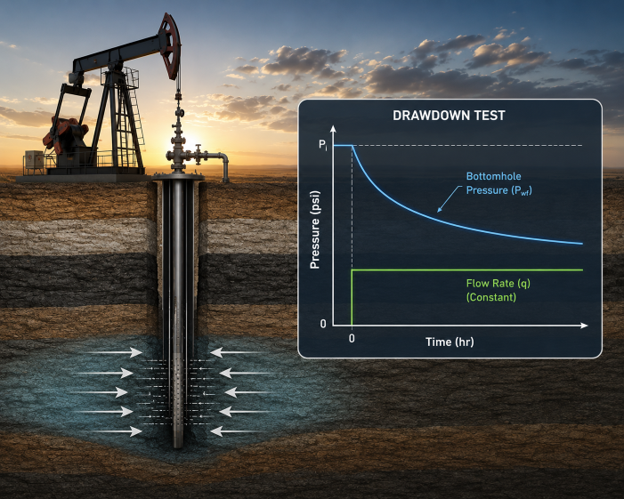
Classical pressure drawdown equations are derived from an idealized mathematical representation of fluid flow through porous media. Their direct application generally relies on several important assumptions:
- Single-phase flow: Only one fluid phase is assumed to be mobile within the investigated reservoir region.
- Slightly compressible fluid: Fluid density and volume change only slightly with pressure.
- Darcy flow: The relationship between pressure gradient and flow velocity is assumed to remain linear.
- Homogeneous reservoir: Reservoir properties such as permeability and porosity are assumed to be spatially uniform in the classical model.
- Constant fluid and rock properties: Parameters such as https://glossary.slb.com/en/terms/p/pressure_transient_analysis?utm_source=chatgpt.comviscosity, compressibility, permeability, and formation volume factor are assumed to remain constant during the test.
- Constant production rate: The ideal drawdown solution assumes that the well is produced at a constant rate from the beginning of the test.
- Adequate test duration: The test must continue long enough for the pressure transient to investigate the reservoir region and develop the flow regimes required for interpretation.
Real reservoirs and field operations, however, rarely satisfy all of these assumptions perfectly. Deviations from ideal conditions can significantly alter both the pressure response and the pressure derivative.
Multiphase flow, for example, introduces saturation-dependent relative permeability and mobility changes, meaning that the observed pressure response may no longer represent a simple single-phase diffusivity process. Phase redistribution within the wellbore can generate complex early-time behavior and may be confused with conventional wellbore-storage effects.
Similarly, changing production rates distort the pressure response because the measured pressure at any time reflects the cumulative effect of the previous rate history. In such cases, simple constant-rate drawdown equations may become inadequate, and techniques such as superposition, rate normalization, or deconvolution ma