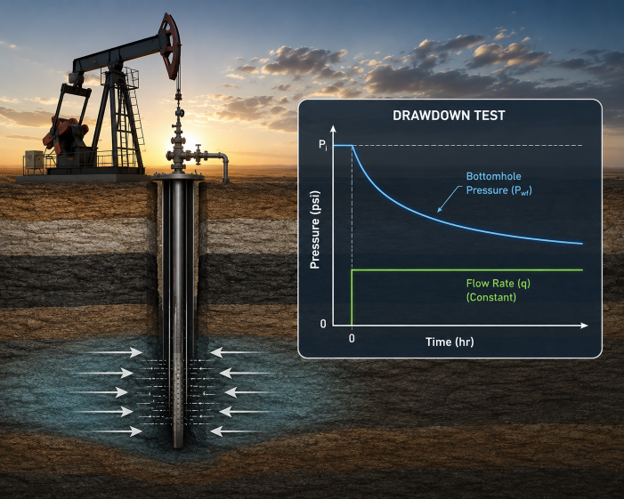
Pressure transient analysis (PTA) is fundamentally an inverse problem. The reservoir itself cannot be directly observed during a well test; instead, engineers record changes in pressure and flow rate and use these responses to infer the underlying reservoir structure, flow geometry, boundaries, and near-wellbore conditions.
This is why flow-regime identification must precede parameter estimation. A permeability value calculated from the wrong flow regime may be mathematically correct but physically meaningless.
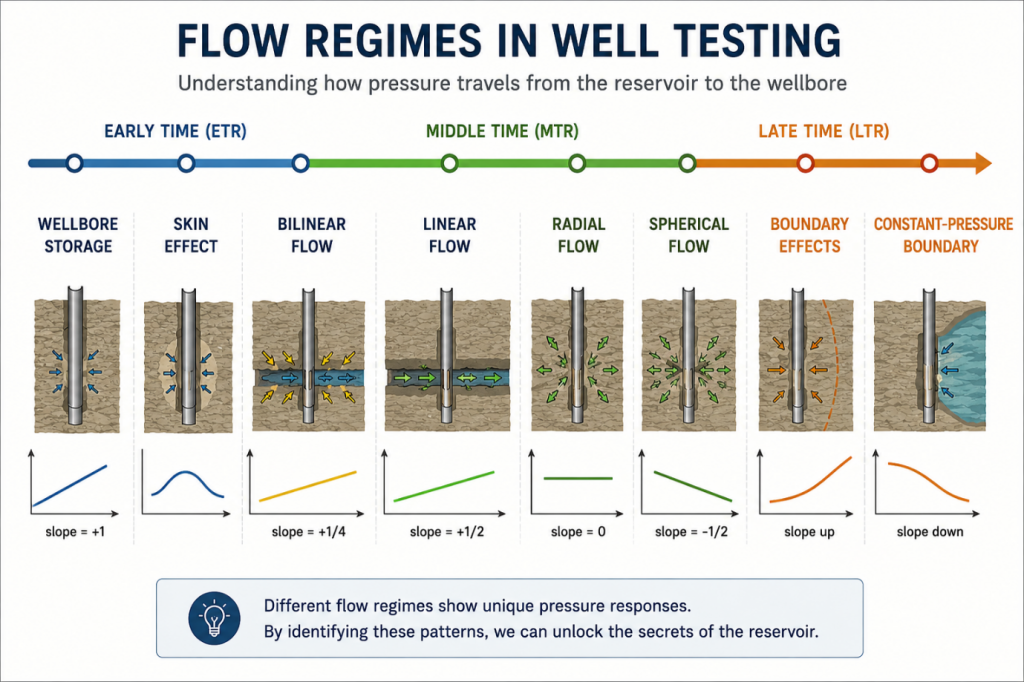
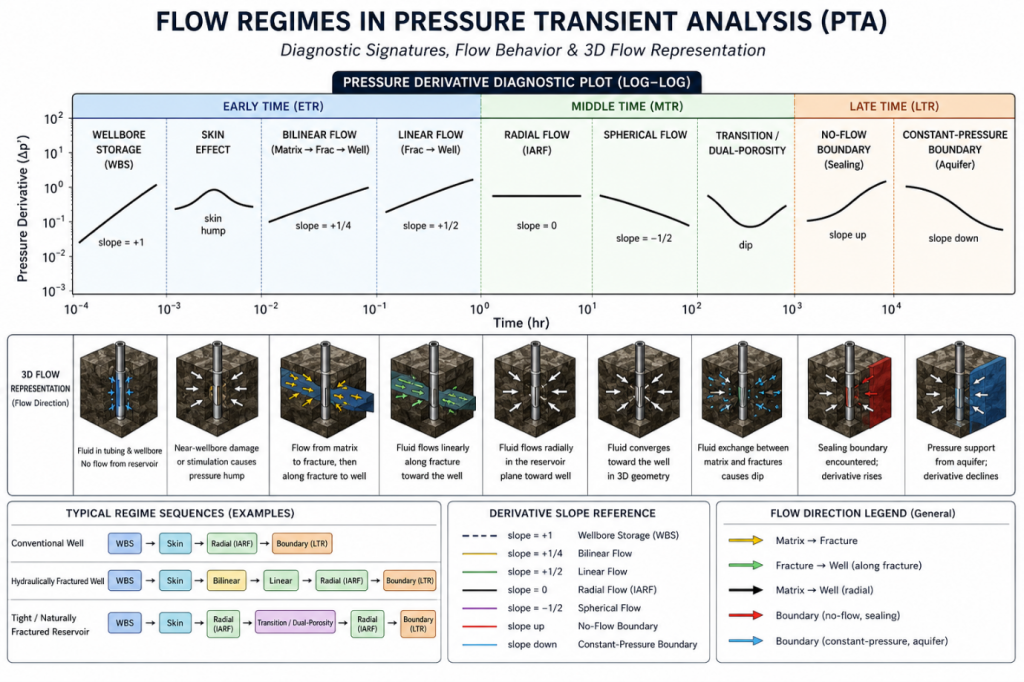
Modern well test interpretation therefore relies heavily on the log-log diagnostic plot, where pressure change (Δp) and pressure derivative (Δp′) are plotted against elapsed time. Different flow geometries generate characteristic derivative responses, allowing the analyst to recognize how pressure disturbance propagates through the well-reservoir system.
However, these signatures should not be treated as rigid templates. Real pressure responses may be distorted by wellbore storage, skin, changing rates, multiphase flow, reservoir heterogeneity, gauge noise, and overlapping flow regimes. Interpretation therefore requires both pattern recognition and physical reasoning.