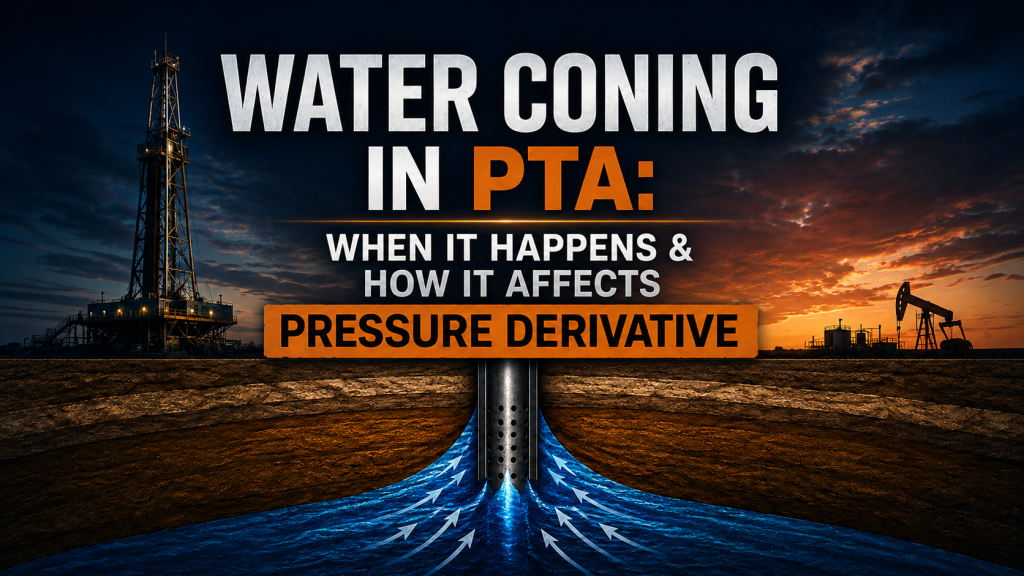
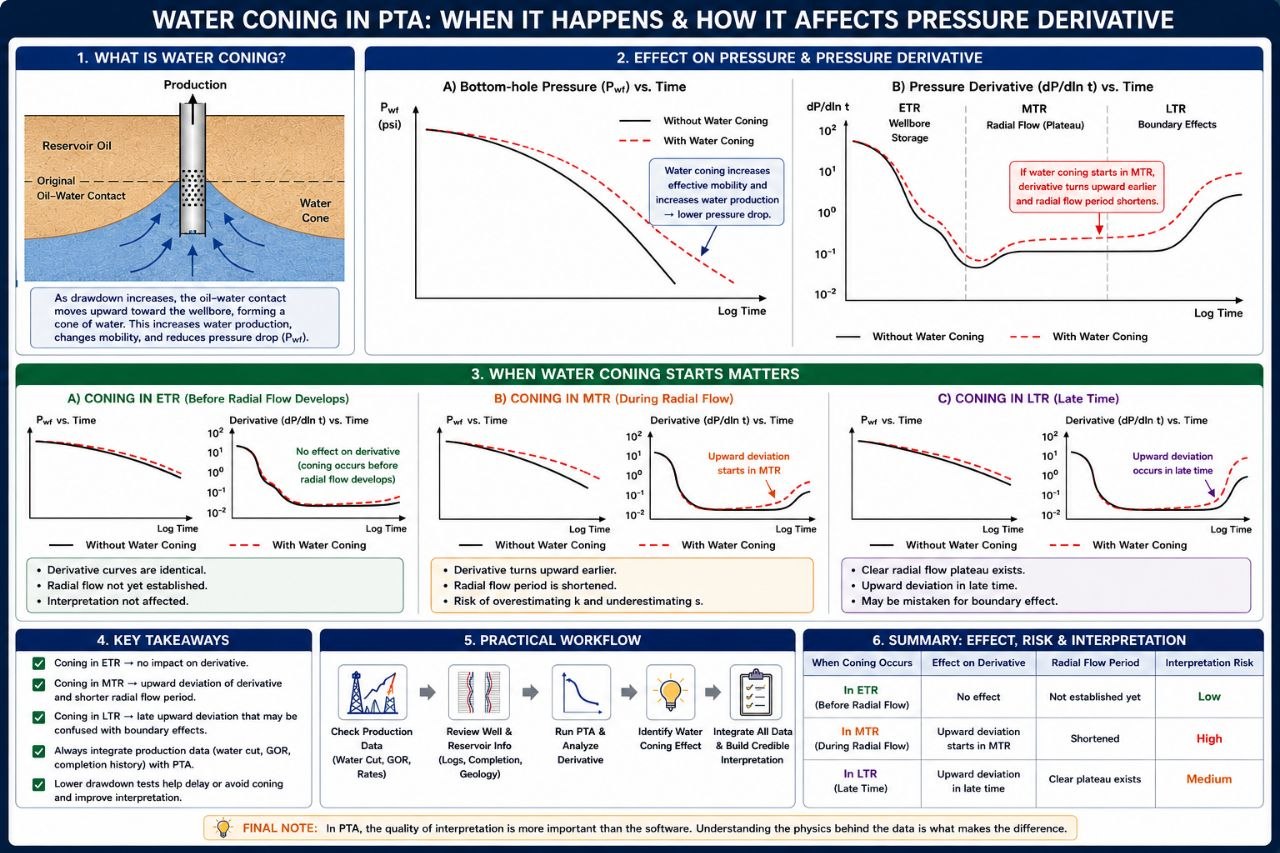
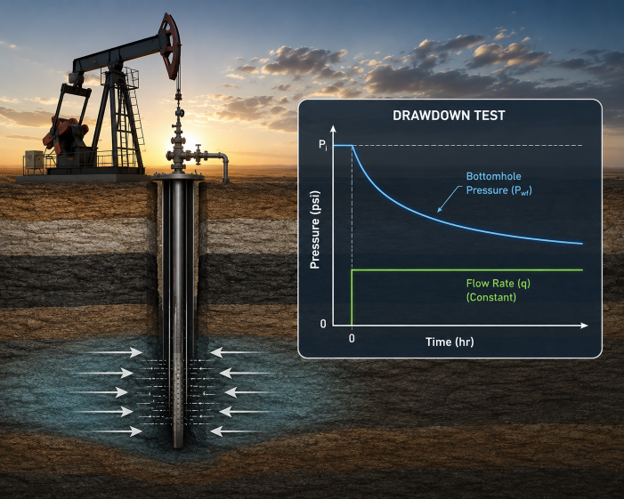
The Water Coning phenomenon in oil wells significantly impacts Pressure Transient Analysis by distorting the pressure derivative curve. As drawdown pressure increases, the water oil contact surface assumes a conical shape, altering fluid mobility and the pressure response.
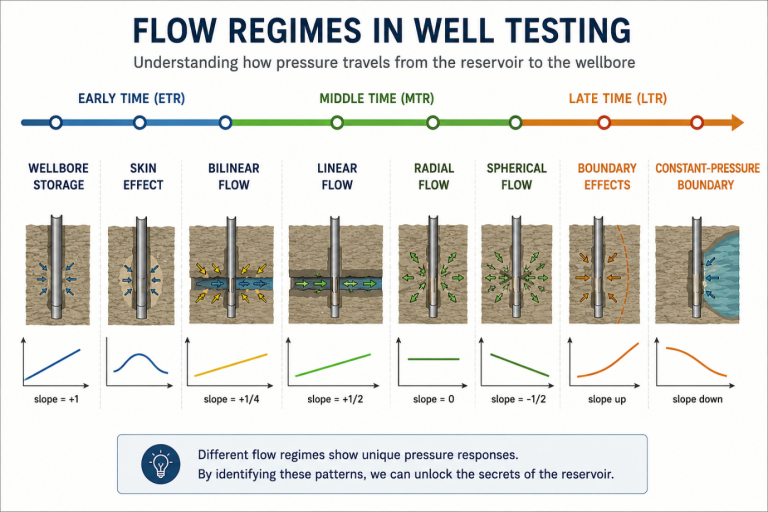
One Early Time Region. This region is primarily dominated by Wellbore Storage. Water coning typically has minimal direct impact here as flow has not yet sufficiently developed near the wellbore.
Two Middle Time Region. Typically characterized by Radial Flow, appearing as a horizontal plateau on the derivative plot. Water coning shortens this radial flow period, causing premature upward deviation, which creates a high risk of overestimating permeability and underestimating the skin factor.
Three Late Time Region. Upward deviation is most pronounced in this region. Weak coning often manifests as late time deviation, which is frequently misidentified as a Boundary Effect.
Summary of Impact on Parameters and Interpretation
The effect of water coning on parameter interpretation depends on its severity.
One When the severity of coning is strong, radial flow does not form, which means there is no plateau, leading to errors in determining permeability and the skin factor.
Two In cases of medium severity, the radial flow period is significantly shortened, requiring very high precision in history matching for interpretation.
Three With weak severity, the upward deviation occurs in the late time, which may be incorrectly interpreted as boundary effects or reservoir heterogeneity.