
Comprehensive Well Test Analysis Course | Learn Pressure Transient Analysis & Well Testing

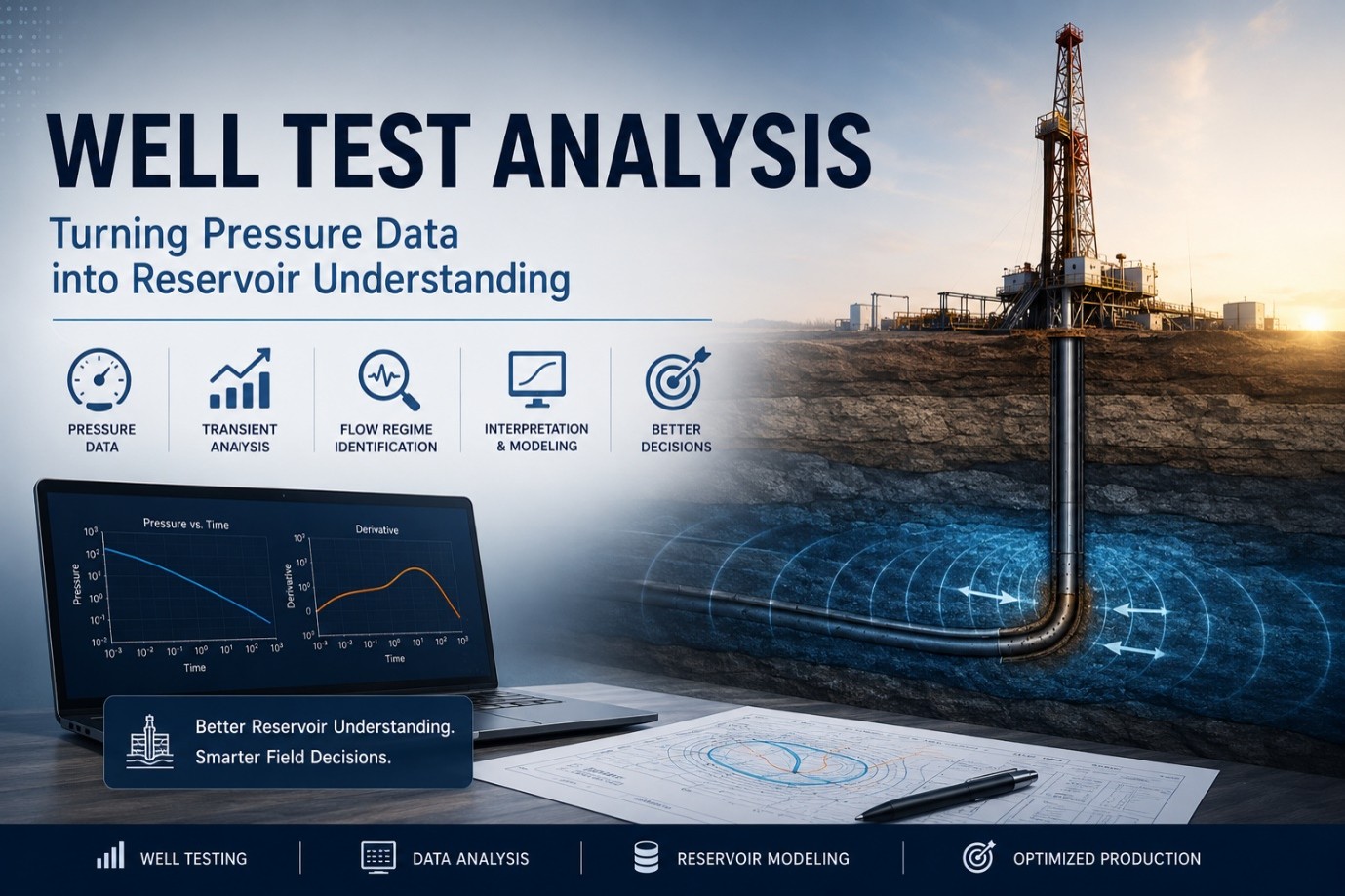
Comprehensive Well Test Analysis: From Pressure Data to Reservoir Understanding
Every pressure change recorded during a well test contains information about the reservoir. The challenge is learning how to decode it.
A well test can reveal how easily fluids move through the reservoir, whether the near-wellbore region is damaged or stimulated, how fractures influence flow, whether reservoir boundaries have been reached, and how different parts of the reservoir communicate. However, extracting this information requires more than applying equations or matching curves in software. Reliable interpretation depends on understanding the complete relationship between well operations, pressure and rate acquisition, transient behavior, flow regimes, reservoir models, and field conditions.
Well Test Analysis therefore connects what happens in the field with what is observed on the diagnostic plot. A pressure response measured during production, shut-in, or injection is transformed into a dynamic picture of the well–reservoir system.
This guide follows that complete journey—from the fundamentals and major types of well tests to Pressure Transient Analysis (PTA), superposition, pressure-derivative interpretation, flow-regime identification, reservoir-model selection, software-based analysis, and practical field applications. It also highlights the common interpretation mistakes that can lead to technically convincing but physically incorrect conclusions.
What Is Well Test Analysis in Reservoir Engineering?
Well Test Analysis is the process of collecting and interpreting pressure and flow-rate data from an oil or gas well to determine the physical properties of the reservoir and evaluate well performance.
Engineers use well testing to answer critical questions such as:
- How permeable is the reservoir?
- What is the skin factor?
- Is the well damaged?
- Where are reservoir boundaries located?
- Is there communication between wells?
- What is the well’s deliverability and production potential?
The objective is not simply to calculate reservoir parameters, but to build a physically consistent interpretation of the well–reservoir system from its dynamic pressure response.
Why Is Well Test Analysis Important in Reservoir Engineering?
Unlike static measurements, well testing investigates the reservoir dynamically. By observing how pressure responds to production, injection, or shut-in, engineers can evaluate reservoir properties, well performance, connectivity, boundaries, stimulation effectiveness, and pressure support under actual flow conditions. This makes well testing an important bridge between reservoir characterization and field decision-making.
Types of Well Tests in Oil and Gas Reservoirs
Not every well test asks the same question. Some tests observe pressure while a well is producing, others after shut-in, during injection, or through the response of an offset well. The test design determines what part of the well–reservoir system can be investigated.
1. Pressure Drawdown Test in Well Testing
A drawdown test records the pressure response after a well is opened to production, ideally at a controlled rate. During this test, the well is opened at a nearly constant production rate while bottom-hole pressure is continuously recorded.
Objectives of Drawdown Testing
- Estimate reservoir permeability
- Calculate skin factor
- Evaluate well productivity
- Detect wellbore storage effects
- Analyze near-well reservoir conditions
Advantages
- Fast data collection
- Suitable for new wells
Limitations
Sensitive to production rate fluctuations
Requires accurate pressure gauges
Difficult interpretation in heterogeneous reservoirs
2. Pressure Build-Up Test Analysis
A Pressure Build-Up Test begins after a production period when the well is shut in. As production stops, reservoir pressure gradually increases toward its original value. This pressure recovery contains valuable information about reservoir behavior.
Build-Up Tests are used to determine
- Reservoir pressure
- Permeability
- Skin factor
- Reservoir boundaries
- Formation damage
- Productivity Index
Because the well is shut in during pressure acquisition, buildup testing avoids the difficulty of maintaining a constant producing rate during the observation period, although the previous production history must still be properly accounted for.
3. Injection Well Testing and Pressure Analysis
Injection Tests are performed by injecting water or gas into the formation while monitoring pressure response.
These tests help engineers understand:
- Injectivity
- Formation permeability
- Reservoir communication
- Waterflood performance
- Enhanced Oil Recovery (EOR) projects
Injection testing is widely used in mature oil fields where pressure maintenance is critical.
4. Pressure Falloff Test in Injection Wells
A Falloff Test is the injection-well counterpart of a pressure buildup test. After a period of injection, the well is shut in and the subsequent pressure decline is recorded. The response can be analyzed to evaluate injectivity, formation transmissibility, near-wellbore effects, and reservoir boundaries. Falloff testing is particularly important in water injection, pressure-maintenance, disposal, and EOR operations.
5. Interference Testing for Reservoir Connectivity
Interference Testing evaluates pressure communication between two or more wells.
One well is produced or injected while pressure changes are monitored in nearby observation wells.
Applications include:
- Reservoir continuity
- Fault identification
- Communication between wells
- Reservoir compartmentalization
- Field development planning
6. Drill Stem Test (DST) in Oil and Gas Wells
Drill Stem Testing is performed during drilling before completion.
It provides early information about:
- Reservoir pressure
- Formation productivity
- Fluid type
- Formation damage
- Commercial viability
DST results often determine whether drilling operations should continue or the well should be abandoned.
7. Gas Well Deliverability Testing Methods
Deliverability Testing measures the maximum production capability of a gas well. Common gas-well deliverability tests include Flow-After-Flow, Isochronal, and Modified Isochronal testing. These tests evaluate the relationship between production rate and flowing pressure and are used to estimate gas-well deliverability and Absolute Open Flow (AOF).
It is commonly used to calculate:
- Absolute Open Flow
- Gas productivity
- Future production capacity
Gas field development relies heavily on accurate deliverability testing.
Superposition in Well Test Analysis: Variable Rates and Multiple Wells
Classical well-test solutions are often introduced using a single constant-rate change. Real wells, however, rarely operate under perfectly constant conditions. Production and injection rates change with time, and the measured pressure response reflects the cumulative effect of the entire previous rate history.
The principle of superposition allows complex pressure responses to be represented as the combined effect of multiple rate changes. The same concept can also be extended to multiple wells, where production or injection from neighboring wells contributes to the observed pressure response.
Understanding superposition is therefore essential before moving from ideal analytical examples to real field data.
Pressure Transient Analysis (PTA): Turning Pressure Data into a Reservoir Model
Pressure Transient Analysis (PTA) is the process of analyzing the pressure response generated when the flow rate of a well changes. Opening a well to production, shutting it in, changing its production rate, or injecting fluid creates a pressure disturbance that propagates through the reservoir.
The way this disturbance evolves with time is controlled by the physical characteristics of the well–reservoir system, including permeability, fluid and rock properties, reservoir geometry, well completion, fractures, heterogeneity, and boundaries. By analyzing the measured pressure and rate history, engineers attempt to infer these unknown reservoir characteristics.
This makes PTA fundamentally an inverse problem. In a forward problem, the reservoir model and its properties are known, and the expected pressure response is calculated. In PTA, the measured pressure and rate responses are known, while the reservoir model and its parameters must be identified.
The interpretation process generally seeks to answer two different but closely related questions:
What is the reservoir model?
The analyst first determines the physical behavior responsible for the measured response. This may involve identifying wellbore storage, radial flow, linear or bilinear flow, spherical flow, naturally fractured behavior, reservoir boundaries, or other well and reservoir effects.
What are the reservoir parameters?
Once a physically consistent model has been identified, the pressure response can be used to estimate parameters such as permeability, flow capacity (kh), skin factor, fracture characteristics, boundary distances, and connected reservoir volume, depending on the available flow regimes and test duration.
This distinction is critical because parameter estimation without correct model identification can produce mathematically valid but physically incorrect results.
How to Identify Flow Regimes in Pressure Transient Analysis
Traditional well-test interpretation used Cartesian and semilog plots to identify characteristic pressure behavior and estimate reservoir parameters. These methods remain valuable, particularly when a clear Infinite-Acting Radial Flow (IARF) period is present.
Modern PTA, however, relies heavily on the log-log diagnostic plot, where pressure change and pressure derivative are examined together. The pressure derivative amplifies changes in transient behavior and makes different flow regimes easier to recognize.
A horizontal derivative plateau may indicate radial flow, while characteristic positive or negative slopes can provide evidence of linear, bilinear, spherical, wellbore-storage-dominated, or boundary-influenced behavior.
However, PTA is not simply a process of matching derivative shapes to textbook patterns. Different physical models can sometimes generate similar responses, and real field data may be affected by changing flow rates, wellbore storage, phase redistribution, multiphase flow, non-Darcy effects, fractures, reservoir heterogeneity, pressure-dependent properties, and gauge noise.
For this reason, a reliable interpretation must integrate:
- Pressure and flow-rate history
- Log-log diagnostic behavior
- Semilog and Cartesian responses
- Well and completion geometry
- Geological information
- Fluid and reservoir properties
- Operational conditions
The objective of PTA is therefore not merely to obtain a numerical value for permeability or skin. The ultimate goal is to develop a physically consistent well–reservoir model that explains the complete measured pressure response.
This is why pressure-derivative analysis and flow-regime identification form the next critical stage of the interpretation process.
Pressure Derivative Analysis and Flow Regime Identification
Modern Well Test Interpretation relies heavily on pressure derivative curves.
Derivative analysis allows engineers to recognize different flow regimes that cannot easily be identified from pressure data alone.
Typical flow regimes include:
- Wellbore Storage
- Radial Flow
- Linear Flow
- Bilinear Flow
- Boundary Dominated Flow
- Fracture Flow
- Spherical Flow
Correct interpretation of derivative plots significantly improves the accuracy of reservoir characterization. Each flow regime represents a different geometry or physical mechanism of fluid movement. A unit-slope trend may indicate wellbore storage, a horizontal derivative plateau is associated with radial flow, while characteristic half- and quarter-slope trends may indicate linear and bilinear flow. Spherical flow, naturally fractured reservoirs, and different boundary conditions generate other diagnostic responses.
The important point is that these signatures should not be interpreted as isolated shapes. Their timing, sequence, duration, and consistency with the well completion and geological model determine their physical meaning.
Best Well Test Analysis Software for Pressure Transient Analysis
Once the reservoir behavior has been diagnosed, software becomes the environment where the interpretation is tested—not a substitute for the interpretation itself. Some of the most widely used industry tools include:
- KAPPA Saphir (Ecrin)
- PanSystem
These software packages help engineers:
- Import pressure data
- Build reservoir models
- Analyze pressure derivatives
- Estimate permeability
- Evaluate skin factor
- Detect reservoir boundaries
- Generate engineering reports
However, software alone cannot replace a solid understanding of pressure-transient theory and reservoir engineering principles.
Well Test Analysis Applications in Reservoir Engineering
Well-test interpretation directly influences field decisions. The results may be used to evaluate stimulation performance, investigate reservoir connectivity, calibrate simulation models, assess injection performance, identify development constraints, and improve reservoir-management strategies. A pressure transient is therefore more than a curve on a diagnostic plot. Correctly interpreted, it becomes evidence for decisions involving wells, reservoirs, and field development.
Common Well Test Interpretation Mistakes and How to Avoid Them
Many engineers struggle with Well Test Interpretation because they focus only on software outputs instead of understanding the underlying reservoir physics.
Some of the most common mistakes include:
- Ignoring Wellbore Storage
Early-time pressure data is often dominated by wellbore storage. Interpreting this region incorrectly can produce inaccurate permeability and skin factor values.
- Using Incorrect Flow Rates
Pressure Transient Analysis assumes accurate production rates. Even small flow-rate errors may significantly affect interpretation.
- Selecting the Wrong Reservoir Model
Matching the data mathematically does not necessarily mean that the selected model is physically correct. Different reservoir models can sometimes produce similar pressure responses, making geological and completion consistency essential. Choosing a homogeneous reservoir model for a naturally fractured reservoir leads to incorrect conclusions.
- Misreading Pressure Derivative Curves
A derivative slope is diagnostic evidence, not proof of a particular reservoir model. The complete sequence of flow regimes must be interpreted. Pressure derivatives reveal flow regimes, boundary effects, and fractures. Engineers who ignore derivative analysis often miss critical reservoir information.
- Insufficient Shut-In Time
Pressure Build-Up Tests require enough shut-in time to observe radial flow. Ending the test too early limits interpretation quality.
- Over-Reliance on Software
Software such as KAPPA Saphir provides powerful interpretation tools, but engineering judgment remains essential. Understanding reservoir behavior is more important than simply obtaining a numerical match.
Well Test Analysis Workflow: From Pressure Data to Reservoir Model
A reliable well test interpretation is not produced by importing pressure data into software and selecting the model that gives the best visual match. It is a structured engineering process in which each step builds on the previous one.
The workflow begins with data quality control. Pressure measurements, flow-rate history, test timing, gauge behavior, fluid properties, and operational events must be reviewed before interpretation begins. Poor-quality input data or an incorrect rate history can distort the pressure response and lead to a misleading reservoir model.
The next step is diagnostic analysis. Pressure change and pressure derivative are examined across appropriate plotting scales to identify the characteristic behavior of the well–reservoir system.
Once the diagnostic response has been evaluated, the analyst identifies the dominant flow regimes. These may include wellbore storage, radial, linear, bilinear, spherical, naturally fractured behavior, or late-time boundary effects. The sequence and duration of these regimes provide the foundation for selecting an appropriate physical model.
A well and reservoir model is then selected based not only on the pressure response, but also on the known geology, completion configuration, well geometry, fractures, and operational conditions.
After model selection, the relevant reservoir and well parameters are estimated. Depending on the test response, these may include permeability, kh, skin, fracture properties, boundary distances, and connected reservoir volume.
The interpretation is then tested through simulation and history matching. The calculated model response is compared with the measured field data, and model parameters are refined until the interpretation provides a consistent match across the relevant diagnostic plots.
Finally, the results must undergo geological and operational validation. A mathematically good match is not sufficient if the resulting model contradicts the known reservoir geology, completion design, or field behavior.
The complete workflow can therefore be summarized as:
Data & Rate QC → Diagnostic Analysis → Flow-Regime Identification → Well/Reservoir Model Selection → Parameter Estimation → Simulation & History Matching → Geological & Operational Validation
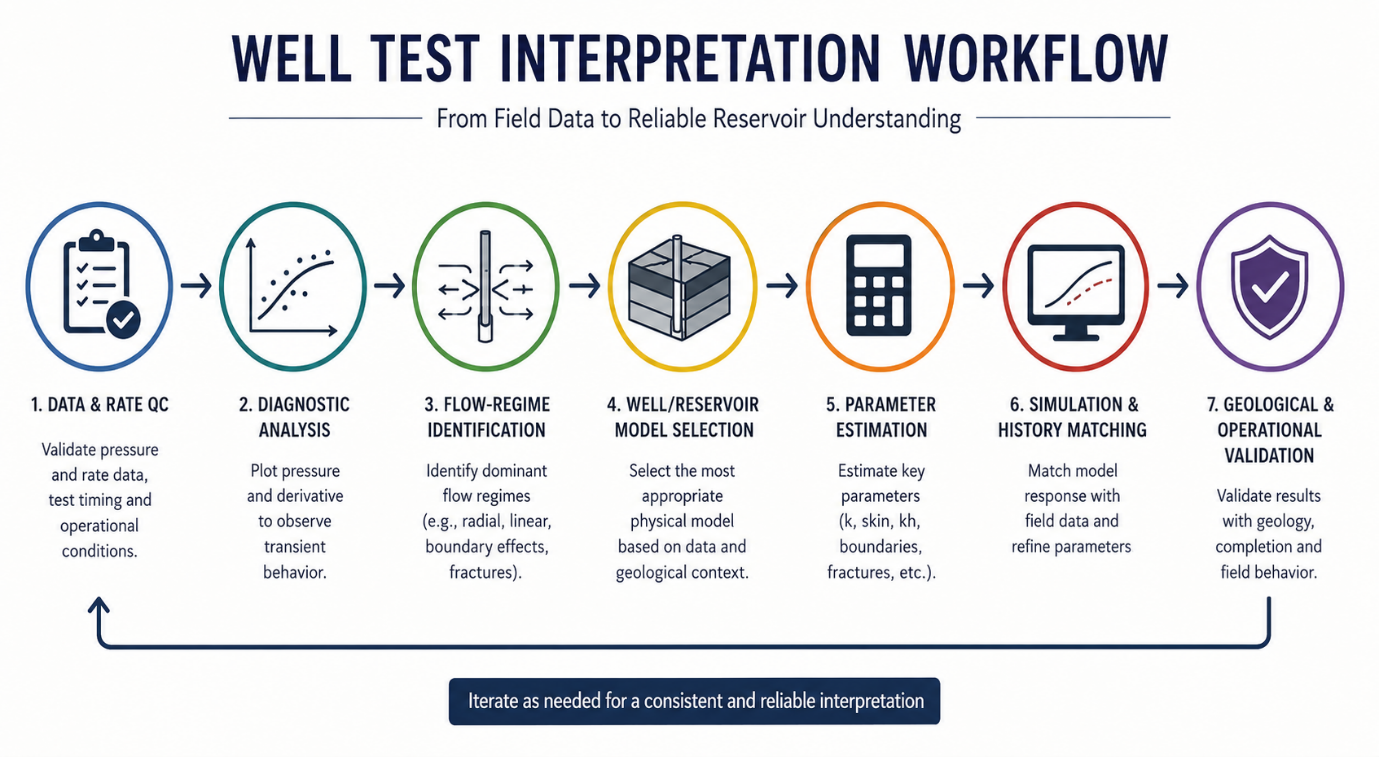
This structured workflow reduces the risk of forcing a mathematical solution onto the data and helps ensure that the final interpretation is both analytically consistent and physically meaningful.
Who Can Benefit from Advanced Well Test Skills?
Well-test interpretation is particularly valuable for petroleum, reservoir, production, well-test, completion, and field engineers, as well as students and researchers seeking a deeper understanding of dynamic reservoir behavior. The skill is relevant across operators, national and international oil companies, consulting organizations, and oilfield service companies.
From Theory to Field Operations: The Complete TeachDemy Well Test Learning Path
Well test analysis cannot be mastered by learning equations or operating software alone. A complete understanding requires connecting Fundamentals, Test Types, Superposition, Flow Regimes & Models, Sensitivity Analysis, Software, Four Cases & Real Data, Surface Operations & Equipment, and Downhole Memory Gauges within a single engineering workflow.
TeachDemy’s Comprehensive Well Test Analysis Course is designed around this complete approach. The course begins with a review of the essential reservoir, fluid-flow, and pressure-transient concepts required for well test interpretation before progressing from fundamental theory to advanced analysis and practical field applications.
Participants study the major pressure-transient testing methods, including Drawdown, Pressure Build-Up, Injection, Falloff, and Interference Tests, together with gas-well Deliverability Testing, including Flow-After-Flow, Isochronal, and Modified Isochronal Tests.
The course also provides comprehensive coverage of superposition, including pressure responses generated by multiple rate changes and multiple wells, enabling learners to understand how complex production histories influence measured pressure behavior.
A major part of the program is dedicated to pressure-derivative interpretation and flow-regime identification. Participants investigate wellbore storage, skin effects, radial, linear, bilinear, and spherical flow, naturally fractured and dual-porosity behavior, and the responses associated with different reservoir boundaries, well configurations, and reservoir models. Sensitivity analyses are used to demonstrate how changes in reservoir and well parameters alter the pressure and derivative response.
The course then moves from analytical interpretation to a complete software-based well test workflow. The software environment is explained from the ground up, including project setup, data preparation, model selection, diagnostic interpretation, parameter estimation, simulation, and history matching. Four complete examples are analyzed, including a real field dataset, allowing participants to follow the interpretation process from raw data to the final reservoir model.
Unlike courses focused only on pressure-transient theory or software operation, this program also covers the operational side of well testing. Participants learn the purpose, configuration, and operation of surface well-testing equipment, the different types of surface well tests, operational workflows, equipment functions, and practical field challenges.
The program further covers downhole well-testing operations using memory gauges, explaining the workflow from test planning and gauge deployment to pressure acquisition and data recovery. This connects the pressure data used in interpretation with the actual field operations through which those data are obtained.
By integrating theory, analytical interpretation, flow-regime diagnosis, reservoir and well models, sensitivity analysis, software training, real-data analysis, surface testing operations, equipment, and downhole pressure acquisition, the course provides a complete learning path from understanding how well-test data are generated to interpreting them for engineering decision-making.
What You Will Be Able to Do After Completing the Course
By the end of the course, participants will be able to understand the physical principles behind well testing; distinguish and analyze major oil- and gas-well test types; apply superposition to variable-rate and multi-well problems; identify flow regimes from pressure and pressure-derivative responses; distinguish wellbore, reservoir, fracture, and boundary effects; evaluate different well and reservoir models; perform sensitivity analyses; conduct a complete software-based interpretation workflow; analyze real field data; understand surface well-testing equipment and operations; and understand downhole pressure acquisition using memory gauges.
Who Should Learn Well Test Analysis?
This course is designed for:
- Petroleum Engineers
- Reservoir Engineers
- Production Engineers
- Completion Engineers
- Field Engineers
- Oil & Gas Consultants
- Petroleum Engineering Students
- Fresh Graduates
- Researchers working on reservoir studies
No matter your experience level, understanding pressure transient behavior and reservoir interpretation can greatly enhance your technical expertise.