
ESD Panel Explained: Emergency Shutdown Systems vs. Anti-Static Protection

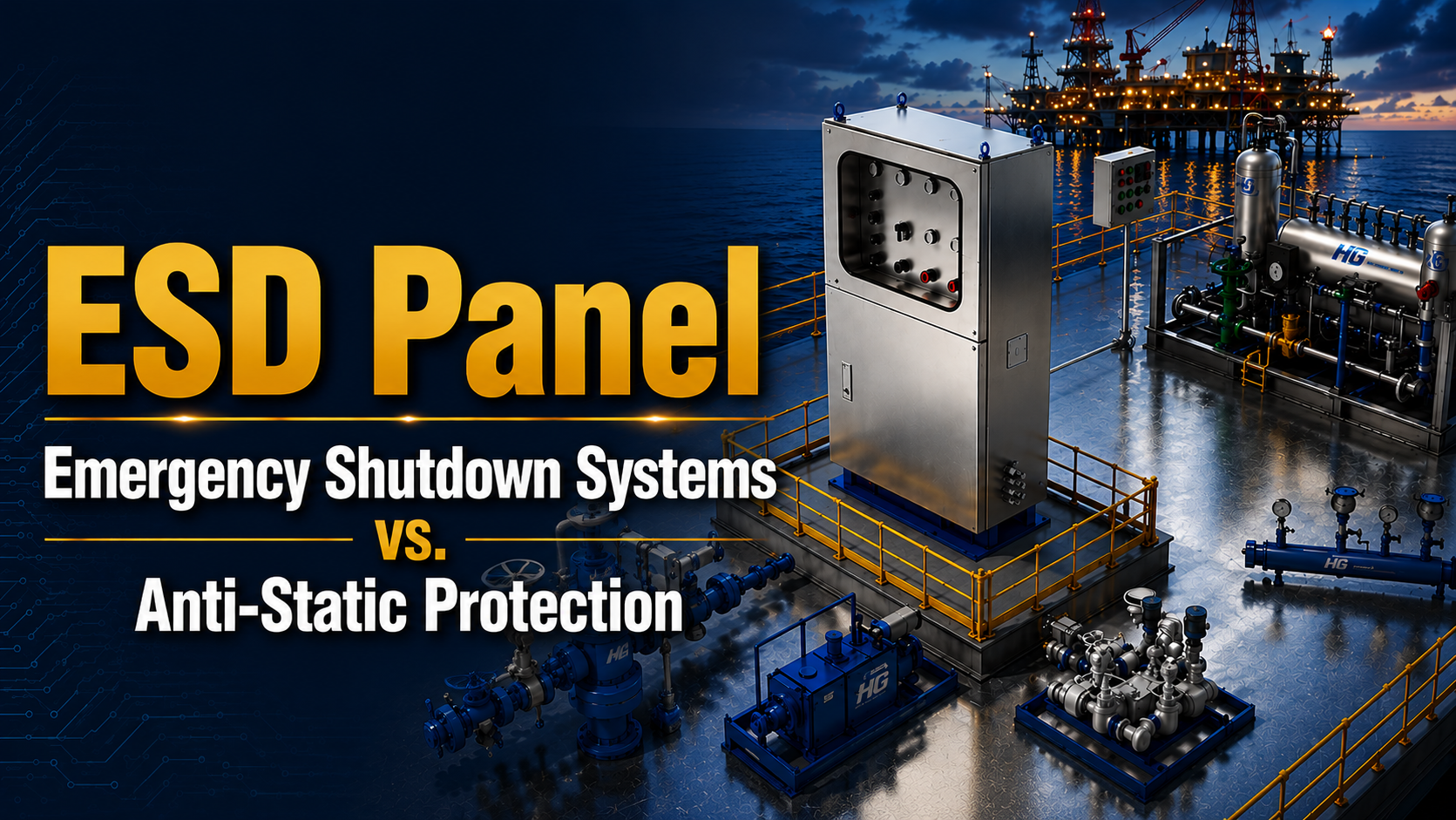
In the engineering world, acronyms are often used across different industries with entirely different meanings. "ESD" is a prime example. Whether you are working on a drilling rig or in a high-tech cleanroom, understanding the specific type of ESD panel required is vital for safety and operational integrity. At TeachDemy, we frequently encounter professionals who need clarity on these two distinct technologies. Let’s break down the differences.
1. ESD in Oil & Gas: Emergency Shutdown Systems
In upstream oilfield operations, an ESD (Emergency Shutdown) Panel is the heartbeat of facility safety. It is designed to act instantly during hazardous situations, such as fires, line ruptures, or critical pipe leaks.
How It Works
The ESD system operates on a failsafe principle. Under normal conditions, hydraulic or pneumatic pressure is maintained to hold process valves open. When a local emergency button is pressed or a remote sensor is triggered, the system vents this pressure, allowing the valves (such as Surface Safety Valves or Flowhead Actuators) to close automatically within seconds, effectively isolating the flow of hydrocarbons.
Key Components of an ESD Control System
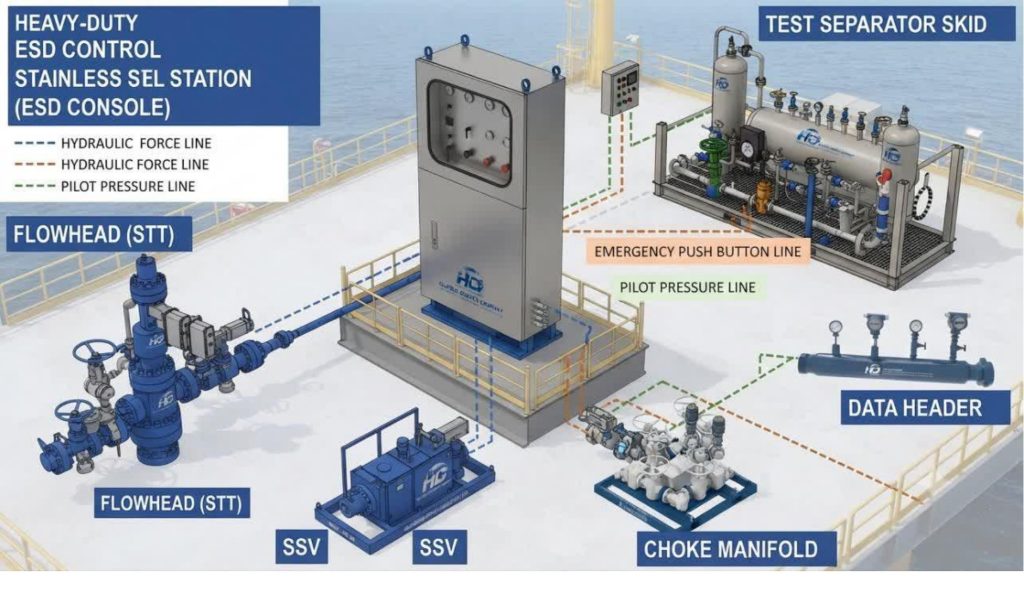
To understand how an ESD system maintains operational integrity, we must examine its critical components and their interconnections, as visualized in the reference diagram:
- ESD Control Station (ESD Console): The central hub that serves as the primary interface for monitoring and executing safety commands.
- Air-Driven Hydraulic Pump: Responsible for generating the necessary hydraulic pressure to activate and hold critical valves in the open position.
- Liquid Tank: A storage reservoir for the hydraulic fluid required to maintain the system's energy.
- Pilot Pressure Lines: These lines transmit essential control signals to activate or deactivate the system's safety functions.
- Emergency Push Button Lines: Dedicated communication paths that immediately send a "Shutdown" command to the system in the event of an emergency.
- Hydraulic Force Lines: The primary conduits that transfer hydraulic power from the console to critical field equipment, including the Flowhead and SSV.
- Surface Safety Valves (SSV) & Flowhead Actuators: Final control elements that automatically isolate hydrocarbon flow upon receiving a signal from the ESD console.
- Data Header & Choke Manifold Integration: These components are linked via hydraulic lines to the ESD system to ensure rapid isolation during pressure fluctuations or hazardous conditions.
2. ESD in Electronics: Electrostatic Dissipative Materials
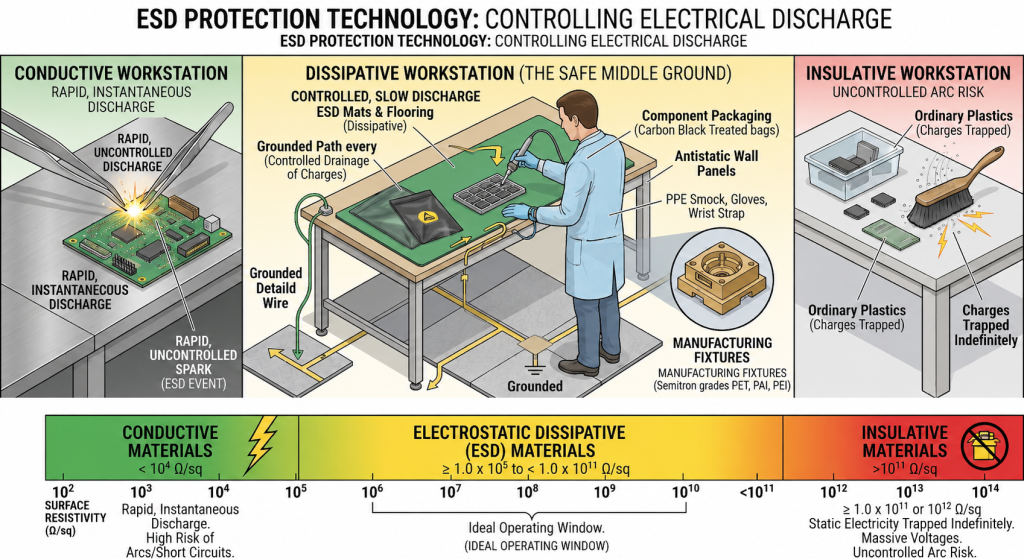
Electrostatic Dissipative (ESD) materials protect sensitive electronic components by controlling the speed of electrical discharge.
The Objective: Safe Middle Ground
While conductive materials drain electricity nearly instantly and insulative materials trap it completely, dissipative materials act as the safe "middle ground". They allow static charges to flow to a ground slowly and predictably, preventing sudden spark-induced damage.
Classification and Resistivity Ranges
The EOS/ESD Association defines materials into three distinct groups based on their surface or volume resistivity:
- Conductive Materials (< 1.0 × 10⁴ or 10⁵ Ω/sq): Provide very low resistance, allowing rapid, instantaneous charge flow. This creates a high risk of current arcs or short circuits near energized components.
- Electrostatic Dissipative Materials (≥ 1.0 × 10⁵ to < 1.0 × 10¹¹ Ω/sq): The ideal operating window for handling active electronics. They bleed off a 5,000-volt charge in milliseconds without generating extreme peak currents.
- Insulative Materials (> 1.0 × 10¹¹ or 10¹² Ω/sq): Ordinary plastics and glass that retain static electricity indefinitely, creating massive voltages until an uncontrolled arc occurs.
Common Applications in Electronics
Dissipative materials are utilized across production, assembly, and logistics environments:
- Component Packaging: Blown films, shipping tubes, and component trays are treated or loaded with carbon black to form classic opaque black or translucent pink dissipative bags.
- Workstations and Flooring: Desktop ESD mats, storage bins, and specialized floor tiles allow continuous grounding paths for technicians and tooling.
- Personal Protective Equipment (PPE): Fabric blends with woven carbon grid fibers are engineered into smocks, gloves, and heel straps to tie human operators into the room's grounding matrix.
- Manufacturing Fixtures: High-performance, structural plastics like Semitron grades (PET, PAI, or PEI formulations) are machined into test sockets, nests, and pick-and-place nozzles.
Material Substrates and Modifiers
Standard base plastics are insulating and require chemical structural alteration to gain dissipative parameters.
Comparison at a Glance
|
Feature |
Oil & Gas ESD |
Electronics ESD |
|---|---|---|
|
Meaning |
Emergency Shutdown |
Electrostatic Dissipative |
|
Function |
Isolate flow / Safety |
Protect circuits / Grounding |
|
Control Method |
Hydraulic / Pneumatic |
Electrical Resistance |
|
Application |
Wellhead SSV, Rig Safety |
Cleanrooms, Circuit Assembly |
Conclusion
Whether you are configuring an ESD panel for a high-pressure wellhead or specifying materials for a sensitive assembly environment, precision is mandatory. Misidentifying these systems can lead to equipment failure or, worse, compromise human safety.
Do you want to master the technical standards of oilfield safety equipment?
Check out our specialized courses at TeachDemy and enhance your engineering expertise today.